

“Many years ago the great British explorer George Mallory, who was to die on Mount Everest, was asked why did he want to climb it. He said, ‘Because it is there.’ Well, space is there, and we’re going to climb it, and the moon and the planets are there, and new hopes for knowledge and peace are there. And, therefore, as we set sail we ask God’s blessing on the most hazardous and dangerous and greatest adventure on which man has ever embarked.”
-John F. Kennedy, Rice University, Sept. 12, 1962
ONE INTRIGUING OCCASIONAL AFTER-EFFECT OF ART is that it can, when conditions are right, be a means to break through the time-space continuum. Case in point: I was recently, upon seeing a recent work of local public art, transported back in time to the year 1962.
1962, at its lowest, was tense, tumultuous, and treacherous. It was, of course, a year of near nuclear oblivion, but it was also a year of massive military movements across the globe in places like Burma, the Dominican Republic, the Congo, and Indonesia; military buildups in East Germany and Vietnam; a military conflict between China and India; and violent civil conflicts in the South.
Despite this atmosphere of warfare, terror, murder, and bloodshed, or perhaps because of it, 1962 was also a year of great cultural highs. The Beatles released their first single in 1962. Andy Warhol painted his first Marilyn Monroes, Elvises, Campbell soup cans, and Coca Cola bottles, and the Sidney Janis Gallery mounted the first group exhibition of Pop artists (“The New Realists”). The Rolling Stones, James Bond, Andrei Tarkovsky (perhaps the best filmmaker no one’s ever heard of) all made their first appearance in 1962, and Lawrence of Arabia, To Kill a Mockingbird, and The Manchurian Candidate became instant film classics — notable each for the innovative story-telling risks they took. And among the great and innovative books published in 1962 were A Clockwork Orange, The Man in the High Castle, One Flew Over the Cuckoo’s Nest, A Wrinkle in Time, The Golden Notebook, One Day in the Life of Ivan Denisovich, Pale Fire, Silent Spring, and Travels with Charley.

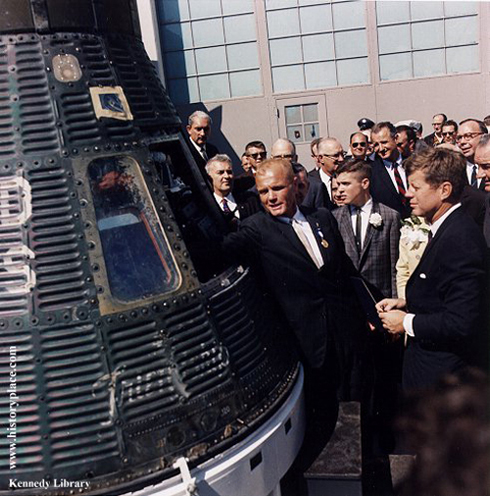
Two events in particular in 1962 had arguably the deepest, most lasting impact on the culture — at least for the decade or two that followed. This was when John Glenn and Scott Carpenter risked all to be the first Americans to orbit the earth. A resulting national frenzy for all things space culminated in September of 1962, when the president uttered his immortal pledge — “We choose to go to the Moon” — in a speech in Houston. Suddenly, kids of all ages were learning how to make junior cadet space helmets, buying Marx mystery space ships and toy rocket launchers, and, if they lived anywhere near Brackett Park in Minneapolis, climbing up a newly installed 30-foot rocket to take imaginary trips to the stars.

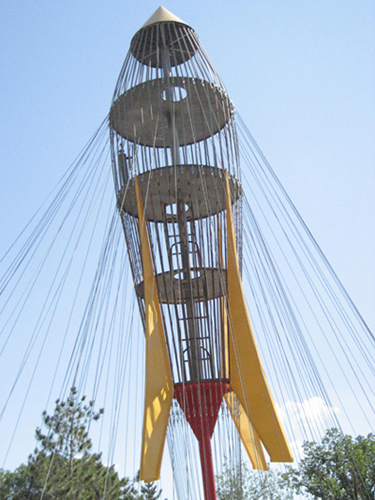
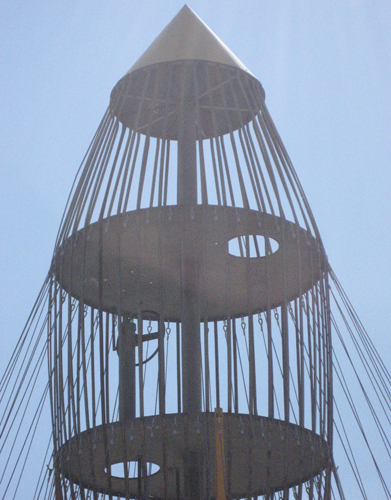
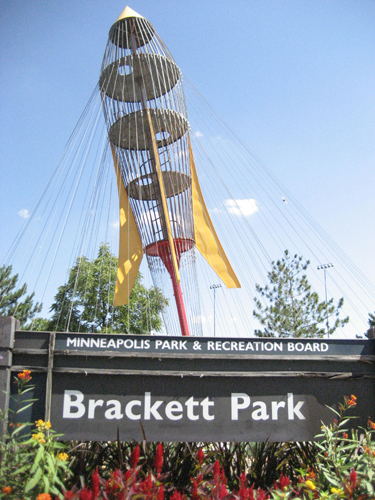
Thanks to art, the Brackett Rocket survives to this day — nearly a half-century later — reminding us of what 1962 was about. Though I’d seen last summer’s reports about the installation of the above work of public sculpture, called “Return Journey” and fabricated in 2007 by Randy Walker, it wasn’t until I saw it recently — passing by on my way to lunch at the Birchwood Café — that I realized the old rocket that once stood in Brackett Park, and that now survived thanks to Forecast Public Art, was similar to the one I had climbed on in the 1960s and 70s as a kid growing up in California. Originally installed in 1962, according to the Minneapolis Parks website, the Brackett Rocket was “a children’s climbing structure symbolic of the entrance of the United States into the ‘space race.’” The rocket was basically a semi-enclosed, upwardly built clubhouse-like structure, with a exterior comprised of a series of metal slats that bowed out gracefully with a kind of classic raygun-like convexity. This allowed children to frolic inside the rocket while still remaining visible to parents. Entry to the rocket was gained by climbing a ladder through a hole cut into a bottom circle of rigidized (RSS.3) sheet-metal. Once inside, a child could decide how much further to climb: into a second, even larger, stage; then into a third stage, wherein lay the rocket’s steering apparatus; and finally into the final stage, the rocket’s claustrophobic, but lofty, nose cone.
The joy of this particular piece of playground equipment — as I remember it from my own childhood playing at Victory Park in Pasadena, California — came not only because it allowed for imaginary star roaming, but because entering, and climbing, the rocket was, at least superficially, a risky act — much like the ones embraced by people like Glenn, Carpenter, Mallory, and Kennedy. You wanted to climb the rocket, because it was there, and it was the tallest thing you’d ever seen on any playground. There was particularly something frightening, exhilarating, perhaps even breathtaking, about attempting to visit the nose cone, mostly because of the height of the ascent, but also because of the likelihood that you’d bump into a kid much bigger and meaner than yourself who wanted the highest spot for himself. And there was also the fact that the thing was damn rickety. The see-through walls, the narrow ladders, the rough metal, the vertigo-inducing open walls — all implied an enter-at-your-own-risk kind of ethos that was a larger part of American life in the 1960s and 1970s.

–Words spoken by Alan Shepard just before launch of the world’s second manned spaceflight mission; this has become known among aviators as “Shepard’s Prayer”
OVER TIME, THE EUPHORIC FRENZY of the 1962 American race-to-space subsided. Some space missions succeeded, and other space missions failed (some spectacularly), as did other missions. Perhaps affected by these failures, the culture grew, over time, subtly more risk-averse. In the late 1990s, safety concerns shuttered, at least partially, the rocket in Brackett Park. Stories circulated at the time that an influential local parent watched in terror as her daughter lodged her head in the rocket’s slat sidewalls. “I cringe when she goes in it,” another parent was quoted in 2004, regarding her own two-year-old daughter. “Aesthetically, it’s nice, but it’s not a safe piece of equipment.” Still, k
ids have a natural curiosity about danger that will ever go against parental risk-aversion — perhaps, in a vicious cycle, leading to ever more parental protectionism. As this story described, local kids loved the Brackett rocket up until the end despite parental fears: “Even on a chilly afternoon, it was worth the trip. From [a local boy’s] perch high above the park, the 10-year-old could grab a makeshift steering wheel and imagine soaring above the clouds… he had few complaints about the 42-year-old rocket.” But no matter; in 2004, the Brackett rocket was completely removed as part of park renovation efforts.
The Brackett rocket, having been built before an age of seatbelts, bike helmets, child safety seats, anti-bacterial soap, children-at-play signs, toy recalls, and anything else we can think to do to protect our children (short of locking them in a padded room), was doomed. Its age was one of risk-taking of the sort that won us the space race but that took a toll on the physical body. Back then, playgrounds looked like they’d been fabricated out of the spare parts of WW II battle cruisers, and they were nearly as dangerous to youthful fingers, knees, elbows, and wrists. The Brackett rocket eventually became victim to changing cultural values that worked to remove the danger, and fun, from the nation’s playgrounds.
The downward slide in playground design, which began in the 1980s, came about specifically from concerns about child fragility that had begun to affect trends in parenting and education. According to a 1989 story in the New York Times, parents were fixated that year on Consumer Safety Commission stats citing 15 deaths and 185,000 serious injuries on playgrounds across the U.S. With such parental watchdogs on the prowl, not only were Brackett-style rockets being examined as unsafe by well-meaning local park boards, but so were old-style jungle gyms and other climbing equipment, traditional monkey bar arrangements, swings, playground surfaces, merry-go-rounds, and any number of playground toys that had served several generations of happily banged-up kids. (Victory Park removed its rocket some time in the 1990s, while parks in other towns, such as Scott Carpenter’s home town of Boulder and the rough western outpost of Dallas, have been taking down their rockets in more recent years). Compounding the situation, playground equipment designers, concerned about increasing ligitiousness in the late 1980s, grew increasingly wary of innovating and exploring new ideas about play. Parents, perhaps due to overstressed, overscheduled lives — and worry about losing control over their children’s safety — began taking kids less often to playgrounds (even as they worked to diminish creative design of playgrounds), and schools began limiting playground time, even to the extreme of canceling recess altogether in some areas.
What’s most ironic, of course — and somewhat depressing — about this playgound protectionism and irrational fear is it occurred just as child-development experts were becoming, according the Times article, “increasingly vocal about the importance of imaginative outdoor play for children.” The playground, explained the experts, was an “arena for physical, mental and social challenge,” a place vital to children’s development. And, according to experts, the new safe and “uninspiring” play spaces were exactly what kids needed least. “Playgrounds,” said David Belfield, a playground design expert, “by their very nature need to be challenging and risky in order to attract children to go back again and keep trying. It is fine for kids to fall over! Government intervention and our nanny state is damaging our children’s development. This will have a lasting impact as they go through life. If we are not careful, we will become a completely risk averse country to the detriment of our growth and prosperity.”
Danger and risk-taking — especially in the relatively controlled, but unsupervised, atmosphere of the playground — is a crucial teacher of children. Putting oneself in (reasonable) harm’s way imparts to a child the importance of approaching risky problems with creativity and chutzpah and style. Again, according to the experts, “… today’s children are missing out on unsupervised play, a critical part of their mental and physical development. Incorporating risk is an important aspect of growing up. We develop from learning by our mistakes and pushing our boundaries and this has to start in childhood.” The fact is a few banged knees, twisted ankles, and split nails or jammed fingers may be among the best teachers we can have in life.
It is all too telling — and in many ways tragic — that, today, playgrounds look less like dangerous, war-surplus scrap metal than something from the back warehouses of IKEA: all designer polyvinyl and off-centric, trapezoidal, globalist shapes meant to nestle perfectly atop a polyfill, low-impact, modern play surfaces. These plastic pre-fab products of the Euro-designer’s imagination offer about as much opportunity for real imaginative play — and real danger — as, well, spending an afternoon stuck in IKEA.


Certainly, the Brackett rocket offered an important object-lesson to any kid who managed to mount the exalted, rarified nose cone: If you overcame your fears and dared to make the climb, then you were rewarded — especially if you lived to tell the tale without too much personal damage. I wonder if the same could be said today about a country too long pampered and protected, about privileged citizens living ever-cushier lifestyles, about politicians who fear administering any sort of necessary, but vote-draining, pills — have we simply grown afraid to face the numerous challenges of the future? Does anyone other than me wonder how John F. Kennedy might have suggested we deal with any of our sundry contemporary dilemmas: Unaffordable housing and health-care, a devaluing currency and ever-ballooning trade deficit, a looming energy crisis, rising ocean levels and increasing environmental stress, loss of industry and job, growing inflation, a widening divide between haves and have-nots, and on and on?
What’s great about this new incarnation of the Brackett rocket is that the sculpture has the power to evoke the spirit of a bygone era and point out every important difference between then and now. It hints at a better version of ourselves — the nation of risk-takers and achievers who made, despite the great dangers surrounding the country, “know how” and “can do” everyday expressions, and an everyday approach to living life.
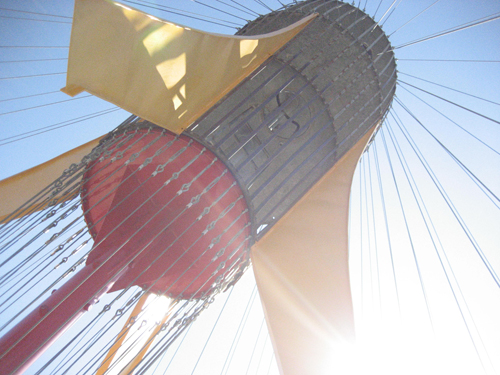
Still, at the same time, “Return Journey” only hints at the former glory of the year it was erected. Mounted on a pole now, removed from its launch position on the ground, it does not allow us truly to go back to that time, just as it blocks any curious child from entering it. Today, outlined against the sky, frozen in mid-act of an impossible lift off, tethered with dozens of guy-wires — the sculpture is a tribute to a million risks taken by a hundred million kids through the years (who once climbed the rocket), but it’s also a mockery of our raging cultural trepidation and
mutual risk-avoidance. Thanks to artist’s anchoring of the structure — whether intentional or not — the Brackett rocket has become nothing more than an outdoor museum piece, removed from its past energy and potential and a sad commentary on our own contemporary cultural ineffectuality.
In the end, we can only marvel that in the much more dangerous year of 1962 the country’s citizens became united in ways that seem impossible now — its creativity focused on one project, its inspiration whetted by one young president enough to make the sacrifices (to the tune of between $20 and $25.4 billion in 1969 dollars in sum for the Apollo project, which amounts to approximately $135 billion in 2005 dollars) necessary to get the job done.
If only we could choose to go to the moon all over again…
Leave a Reply Cancel reply