Beginning Sunday night, Britt Robson, late of City Pages, will be bringing his Timberwolves blog to The Rake. Check back here for the latest, and best, Wolves coverage after every game.
Month: February 2007
-
Cho-Down pt.2
Just a quick and dirty update on the Chodorow vs. Bruni saga …
Apparently, Jeffrey has banned Bruni from all of his restaurants. Not only that, but he’s going to post a picture of Bruni on his website and offer a free vacation for anyone who spots Bruni in a Chodorow joint.
What did I say yesterday about believing your own press?
-
Buca Big House
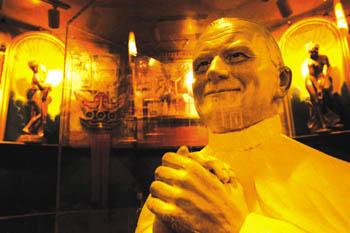
the pope’s tableJoe Micatrotto was sentenced yesterday to 13 months in prison for his illegal actions as head honcho at Buca di Beppo.
I have such odd feelings about this.
As a young something, I believed in the crazy fun and cool world of Buca. I was the first Training Coordinator and running around the country opening restaurants and learning how to grow a national concept.
It was the hardest work I’d ever done and the most fun I’d ever had. We were Una Famiglia and it was great to spread the Buca love to a bunch of fresh and wide-eyed innocents. I talked about humility and having fun and working together as a team, and I believed in every word I spoke. For a while.
The restaurant world is a counter culture, normal rules of “office etiquette” usually don’t apply. So you don’t bat an eye when the dirty jokes flow from all levels, it’s really not that big of a deal. But sometimes, when you’re the only female traveling with an all-male executive team, it wears a little thin.
And when you grow a company, things change, that’s a given. Systems are refined and streamlined to be more efficient. Shorten training to save money? ok. Stick the trainers in the cheapest, rattiest furnished apartments to save money? Uh, ok. Cut a day of learning and add a training party so the Big Cheese can feed all his friends for free? Huh?
The day I truly lost my religion, the day I realized that every word from my mouth was fluff was a sweet day in Pasadena. For over a week I had spent countless hours in front of the trainees talking about how we were there to support them, giving them everything they would need to be successful and confident in their jobs. That night the training party was meant to be a training exercise: we invite people in and buy their food in exchange for their patience and understanding as we practice on them. The number of people invited is held to a manageable amount, so that each server is well paced but never slammed. That way they have the chance to focus on the smaller things that improve service.
But Micatrotto lived near Pasadena, and the invite list grew to an absurd amount. By prime time, the entire restaurant was full and there was a two hour wait. The service staff and trainers were overwhelmed and just trying to survive. I knew that Micatrotto’s son Justin was holding court at a booth in the bar (the tables were supposed to be no more than 4 people, his held 8 or more) and that the server happened to be one of the weaker ones. But instead of having the chance to learn from her mistakes and become a stronger server, she was crushed by the pressure and the disdainful glare of the King of the Company.
Of course she screwed up, that’s what they are supposed to do at training parties. Isn’t it better to mess up on someone who isn’t paying anyway? I went into the kitchen to plead her case with Joe, when I saw him in a fury at the front line. He was checking up on her ticket and realized she had forgotten to order something for Justin’s table. He then started kicking the kitchen equipment and shouting “that f**king c*nt!”. Over meatballs or pasta. Una Famiglia.
I wanted to walk right out the door, but I didn’t. In fact it took me a few more years to realize that I couldn’t save the crazy cool and fun culture I’d loved. The company I’d believed in and helped grow was rotting from the head down.
But I feel sorry for the guy. Prison is a high price to pay for a big ego. And yet … choices were made.
I still crave the lemon chicken and could eat many wheels of the aromatic garlic bread. Under the new management Buca is again a happy place, I am told. In a way I have to appreciate my time under the Micatrotto regime, if only for the lesson I learned: Don’t believe your own press.
-
Best Documentary, in Fragments
More on movies: the film that, in my humble opinion, should’ve won for best documentary is playing at the Bell–through tomorrow only! Not that I disliked An Inconvenient Truth. But let’s face it, folks; it was, essentially, a PowerPoint presentation, whereas Iraq In Fragments took some very bold, and quite poetic, snapshots of three different Iraqi subsets: the neglected Sunni schoolboy; the rambled and radicalized Shiite south; and finally, the seemingly quiet life of a rural Kurdish schoolboy. Rich in hot reds and cool blues, the pictures are beautiful to boot–and considering how difficult the content was to gather, that must’ve been the filmmaker’s happy accident.
-
Gone to the Gowns
If there was one resolution made during last night’s Academy Awards viewing, it was this: I resolve to go see The Queen. I missed it, thinking it looked tearfully boring at the time of its release. Plus, I generally try to avoid biopics–unless, that is, they have something to do with Truman Capote. But in an evening wrought with political handouts and unflattering eveningwear, Helen Mirren was the class-act standout. For one, she wore her dress, by Christian Lacroix, better than anyone else wore theirs–kudos to her to her for daring to wear something so low cut. And at her age!!
(Here’s my parenthetic thoughts on last night’s dresses: Penelope Cruz’s Versace was the best dress, in my humble opinion. I also liked Nicole Kidman’s red Balenciaga number with the big shoulder bow, although her plasticized forehead did nothing for the overall look. Cameron Diaz’s white, origami-inspired Valentino was also nice; this is something I’d actually want to wear! But aside from that, I’m not diggin’ the futuristic metallics, which can make even a starlet look paunchy. Jennifer Hudson, I love you ‘n all, but get rid of that Oscar de la Renta rag–and fast!!)
In any case, for those, like me, who still haven’t seen The Queen, it’s playing at The Heights this evening through Thursday.
-
Conversations Real and Imagined: Scorsese's Acceptance Speech
At the mention of his name, and with a look of profound relief and that usual squirrel-spark in his eyes, Martin Scorsese nods to himself, rises from his chair and makes his way to the stage. Steven Spielberg, George Lucas, Francis Ford Coppola and that tall brunette, whose presence speaks of sold souls, waits to hand Martin his Oscar. Hugs are exchanged. Martin admires the little gold fellow. He steps to the mike, and begins.
Thank you, thank you everybody. Academy members, Steven, Francis, George, boy, this is an honor, thank you so much. I have so many people to thank, I barely know where to begin.
I guess I’ll begin by offering my gratitude to Paul Greengrass, Alfonso Cuaron, Pedro Almodovar, Florian Henckel von Donnersmarck, Guillermo del Toro, and any other director this year who made powerful and original films, much better than my own. It feels strange being up here, looking down at these directors, remembering when I was beaten by films like Rocky and Ordinary People and Dances With Wolves, a trio of perhaps the most embarrassing Oscar wins in its admittedly weak history. I know what it feels like, boys, to think about the little masterpiece you made and watch that big-budget, heavily-marketed, lugubrious film pass you by. Or the award for the guy who gets it just because he’s paid his dues.
See, I paid my dues. I know The Departed is far from my best, ignores so many of the things that made my other films great, and is such a bald-faced attempt at winning the little gold man that it’s nearly embarrassing. But it worked. Now I can move on and make the movies you want me to make.
See, for the longest time I did exactly what I wanted to do, and look at my success–money, popularity, films that are not only acclaimed by critics but the public as well. Good god, you’d be surprised how many people will see me on the streets and go, “You lookin’ at me?” or “You think I’m funny? Funny how? Funny like a clown?” or even that guy at the deli who calls himself Rupert Pupkin, claims that he even had his name changed legally. Well that’s great. It’s wonderful. People know me, they love me. But my best work–just like the best work of the directors I just thanked–didn’t get me one of these.
Now you may ask yourself: why the heck do I care if I get an Oscar, when so many great directors never won the gold? Good question. In fact, a friend of mine–he’s a sommelier at this great little restaurant in wine country–pointed out how similar my career was to Hitchcock’s. Critical and popular. Thrillers that meant more, so much more. Old Hitch’s immortal, just as I will be regardless of whether I ever win one of these. Well, my friend’s right. I don’t know what to say except that these little gold statues are an addiction, I think. I don’t know.
A girl no longer in my employ also pointed out that, for a man who directed the life of the Dalai Lama, I sure seem to have jettisoned my Buddhist belief in rejecting attachment. Again, I have to say she’s right.
The Oscars are a funny thing, aren’t they? I mean, so many people watch them, and tomorrow the sales for The Departed are going to skyrocket. And that’s great. If you’re going to make it in Hollywood, really you have to sell your soul at least a little bit, and if you want one of these, you have to sell your soul a lot. The statue is a way of showing, to a world of people who might want to live a good and decent life, the sacrifices we make when we want to give you Taxi Driver or GoodFellas. I mean, I try to have it both ways, making those little PBS movies about Dylan and the Blues, but really I can’t. I had to hurt or kill a very important part of myself to win an Academy Award, and I did it because… well, I’m still not sure. Right now I’m just giddy to be up here, spilling my guts.
The thing that scares me is this: that same woman who wondered about my Buddhist beliefs also wondered, once I’ve given myself over to making the kind of movies that will win me an Oscar, if I can ever go back. If I can ever be edgy again. Pure. Or if I’m stuck casting guys like DiCaprio and Nicholson, instead of talented, hungry newcomers. If I’ll be able to make the cinema charged with electricity, the way guys like Cuaron and Lynch and Tarantino still do. Guys who don’t give a shit about Oscars.
The answer is that I don’t know.
Well, at least I’ve got my Oscar. That’s out of the way. Francis, you’ve got yours. Stephen, you’ve got yours. Hmm. But I remember, Francis, looking at the your Godfather statuettes, behind that thick glass at your vineyard. I was surprised: yours were almost black. They tarnish so easily, don’t they?
-
Murder by Numbers
Viewed through the prism of memory, some years take on a character, a distinctive tone. In 2006, crime reclaimed its place on the front pages of newspapers across the United States, including the Star Tribune. And in this year of murder, Courtney Brown and Trevor Marsh were like twin poles on a violent globe. Brown died on a Saturday night in September, while walking with friends near the intersection of Lyndale Avenue North and Dowling Avenue. He had been playing basketball. The young man who shot him wanted Brown’s basketball shoes and jersey, a replica of an old Morgan State University uniform. Brown was about to start his sophomore year at Edison High.
Minneapolis had been recording homicides at a rate not seen here in a decade, but Brown’s killing, which occurred on the fringes of Minneapolis’ most troubled neighborhood, struck a chord. Spurred by media attention and aided by cooperative citizens, the police quickly arrested several suspects, including the alleged shooter. He was seventeen. Charges have since been dropped.
Trevor Marsh’s murder occurred nine miles away, bringing a half-dozen squad cars and police barricades to a quiet, middle-class neighborhood. A student at South High, he was shot in the woods near the Mississippi River, below the intersection of Thirty-second Street and West River Parkway. It was October 26. Another South High student had been murdered just three weeks earlier.
Police said little about the circumstances of Marsh’s killing, but rumors swirled at the school and throughout the Longfellow neighborhood, where violent crime is rare. Marsh had been in trouble. He was shot execution style. The killers had taken his shoes, a sign of gang involvement. In late December, Minneapolis police charged two alleged gang members, one of them only sixteen, with Marsh’s murder. According to the criminal complaint, Raine C. Neiss shot Marsh at close range near the left ear because he had lied about being a member of the Gangster Disciples. An eyewitness allegedly told investigators that Neiss was playing Russian roulette with a pistol that Marsh brought to the meeting.
Along the river, a memorial grew and morphed, withered and was revived. A framed photograph in a wicker basket, flowers, balloons. Saints candles. Briefly, a blue bandanna. In December, a Christmas wreath with handwritten notes.
These murders made for two sharply contrasting tales: One victim black, the other white. One lived north, one south. One was the epitome of innocence on the fringes of a troubled neighborhood; the other, apparently living what Minneapolis Mayor R.T. Rybak indelicately called a “high-risk lifestyle,” albeit in a supposedly safe part of the city. And yet each death created the same anguish, confusion, and even rage.
By year’s end, Minneapolis had recorded sixty homicides, thirteen more than in 2005 and the highest number since 1996, when eighty-eight people died violently in the city. Twenty-nine—nearly half—of last year’s killings occurred in a six-square-mile area of North Minneapolis, from Glenwood Avenue north to Dowling, and from the city’s western border to the Mississippi River on the east (minus the North Loop neighborhood in the southeastern corner). According to the 2000 Census, 49,405 people live here, which equates to roughly fifty-four homicides per hundred thousand residents. Were North Minneapolis a separate city, that murder rate would put it just behind such municipalities as Compton, California, and Gary, Indiana. If Longfellow neighborhood had the same homicide rate, there would have been fifteen homicides there in 2006, instead of three; in southwest Minneapolis, there would have been thirty-four instead of the single case—the shooting of graduate student Michael Zebuhr in Uptown—that caused such an uproar last March.
Granted, last year’s total was far below the 1995 record of ninety-nine homicides, which earned the city mention as “Murderapolis” in the New York Times. And, in fact, experts routinely caution against extrapolating from homicide data for a single year, since the numbers involved are relatively small and can be influenced by many factors, including luck. But the Minneapolis-based Center for Homicide Research has used police data and other sources to locate all seven-hundred-odd homicides in Minnesota between 1996 and 2000. Zooming in on Minneapolis shows that nothing substantial has changed between those years and 2006—there are just more dots. “Homicide doesn’t occur randomly,” pointed out Dallas Drake, the center’s principal researcher. “It clusters. It clusters in space and time.”
Minneapolis is not alone. From Orlando to Oakland, Philadelphia to Indianapolis, to Milwaukee, to Little Rock, violent crime, particularly murder, was big news in 2006. Oakland, the San Francisco Chronicle reported last October, “has hit a 10-year high for homicides.” A headline in the Houston Chronicle proclaimed that same month: “Homicide rate on track to be worst in a decade.” Wrote the Orlando Sentinel on November 3: “Death brings murder count to record 44.” In August, the Philadelphia Daily News reported that “blood is spilling at a record rate this year—not only on the streets of Philly—but in supposedly friendlier locales …”
These figures in many cases rose for the second year in a row. “Among violent crimes,” the Washington Post reported, “the biggest rise in 2005 came in the number of homicides, which leapt 4.8 percent, to nearly 17,000. Some of the hardest-hit cities included Milwaukee (up 40 percent), Cleveland (38 percent), Houston (23 percent), and Phoenix (9 percent).” According to recently released FBI figures, violent crime rates accelerated four percent in the first half of 2006. This follows a 2.5 percent increase in 2005, which was the largest increase in a decade.
No matter how it’s broken down statistically, murder is ultimately just a surrogate for the broader perceptions about security and danger that profoundly shape our lives. We focus on homicides, in part, because they can be measured with relative accuracy. Few go unreported; the demarcation between life and death is clear. In legal terms, too, it makes a huge difference: When a man was shot at a downtown Minneapolis bus stop in late November, the fact that he survived meant that the shooter could not be charged with murder. Knowing that the victim survived, however, does not make those who witnessed the shooting, or who wait at that bus stop every day, feel measurably safer.
Among themselves, criminologists often speak of homicide as merely one type of aggravated assault, in which numerous factors—the shooter’s skill, proximity to advanced trauma care, and sheer luck—influence the fate of the victim. A half-inch difference in where a bullet hits can mean the difference between life and death. Researchers at Harvard University and the University of Massachusetts have estimated that the U.S. murder rate would be roughly three times higher without the advances in emergency-room medicine that have occurred since 1960. And so Minneapolis’ overall homicide rate is surely reduced by the proximity of two Level I trauma centers, at Hennepin County and North Memorial Medical Centers.
But trauma surgeons saving the lives of gunshot victims masks the true dimensions of the problem, which is not so much murder as it is violence in general. A better measure of that violence might be a tally of those who are intentionally shot, or shot at, in the city; however, such figures are unfortunately only “semi-accurate,” said Minneapolis police Lieutenant Greg Reinhardt. “You don’t see a gang member saying, ‘I want to make a report that I was shot at.’ They’re going to take care of it themselves.”
Still, even the number of reported shootings in 2006 rose twelve percent over 2005, according to police figures. Aggravated assaults, which include shootings, were up sixteen percent in the same period, and weapons-related arrests were up fourteen percent. Nearly three-quarters of Minneapolis’ homicide victims in 2006 were killed with handguns; a decade earlier, when the city had eighty-eight homicides, handguns were used in about half of them. One logical response to violent crime, then, might be to take away guns from those with a propensity for violence. Police in Kansas City, Missouri, for example, cut gun crimes nearly in half when they dramatically increased enforcement in “gun crime hot spots” of laws that prohibit the carrying of concealed weapons. They took away sixty-five percent more guns than in the previous year. Researchers have reported similar results in other cities, but the methods used to seize those guns have often proved controversial, with frequent charges that police rely on racial profiling to decide whom to search.
At universities and think tanks across the United States, a small cottage industry of researchers has tried to understand why and how murder occurs, and by extension how to curb it. There is even a peer-reviewed journal, Homicide Studies. (From its November 2006 issue: “The Murderer Next Door: Why the Mind is Designed to Kill.”) Like law-enforcement officials, those researchers routinely classify homicides in a variety of ways: by the relationship between victim and killer, say, or by looking at whether illegal drugs or gang membership were involved.
If the goal is to reduce the number of murders, those distinctions make sense. Preventing the death of a young child at the hands of a caregiver (No. 13, three-year-old Ethan Hamilton) or of an intimate partner (No. 43, Martell Delaney) requires a different strategy from, say, stopping drive-by shootings (No. 50, South High student Gennaro Knox ), violent robberies (No. 12, Michael Zebuhr), or drug-related murders (No. 16, Garey Hannah). Likewise, this analysis helps us gauge risk and protect ourselves.
But these distinctions have negative consequences, as well. They inherently place at least part of the blame for murder on the victim. One was buying illegal drugs, a second argued with a gang member, another chose to live with a violent partner. In this crude calculus, it is the random act of violence that haunts urban America. Thus, as the Star Tribune reported in the wake of that November bus-stop murder: “The downtown shooting wasn’t random … The boy was shot by another person who … knew the parties involved.” The subtext: You, dear reader, are safe.
These distinctions create a sort of economy of homicide, in which some lives are more valuable than others. And in this economy, daily news coverage becomes a rough measure of value. Only a handful of the city’s murders in 2006 made front-page news, and those often had a ready-made nickname (the Block E shooting, the Uptown murder), or at least a shocking detail (killed for a basketball jersey). The killing of Michael Zebuhr merited 7,500 words. Including the trial and its aftermath, the death of Alan Reitter, near Block E, generated more than 11,000 words. Michael Eide, shot near Twenty-ninth and Morgan Avenues North, was worth 313. Erman Edmonds, shot on the 3700 block of Columbus Avenue South, warranted 105.
At the very nadir of this process, the act of living in or even visiting a neighborhood plagued by violence tacitly becomes equated with risk. Murder, Drake says, “becomes normal. ‘That’s just a bad neighborhood.’ It becomes acceptable—expected—that homicide will occur there.”
In recent years, researchers in the field of public health have become involved in this discussion of homicide. From their perspective, murder might be seen as a disease that disproportionately afflicts men: In Minneapolis, the murder rate for men (27.9 per hundred thousand residents) is nearly eight times higher than it is for women (3.6). Homicide disproportionately affects African Americans, especially men: Their murder rate in Minneapolis (eighty-seven per hundred thousand) is about fifteen times that of white men (5.6). Homicide rates for black male teenagers (202 per hundred thousand) and black men aged twenty to twenty-nine (244 per hundred thousand) are staggeringly high. (The rates for whites are fifteen and eleven, respectively.) As with the maps plotting out murder locations in Minneapolis, these figures remain fundamentally consistent, year after year, decade after decade, both here and in many American cities.
Not that plenty of people aren’t trying to reduce the violence, using myriad strategies, both obvious (a police juvenile-crime apprehension unit, gun buy-back programs, increased patrols in hot spots, the new “Shotspotter” technology) and not so obvious (nonprofit organizations that rehabilitate problem properties).
We also talk good. Last August, Mayor Rybak spoke of public safety as a “civil right.” Quoting the mayor, the Strib wrote an impassioned editorial, pointing out how angry we would be if armed thugs terrorized the streets of Edina. Governor Pawlenty called the violence in Minneapolis “a statewide concern.” We write this article.
But lacking a coherent, systematic plan to address violence, all of the above amounts to tinkering. Some years see more cops added to the police force, or more dollars budgeted for overtime. But by leaving the problem to the cops (as though a thousand more officers might alone solve the problem), we forget that our safety depends most on voluntary adherence to law. As a city and state, we make a cost-benefit analysis, essentially deciding that a certain number of lives are expendable.
By contrast, Boston radically reduced its youth homicide rate in the 1990s with a comprehensive, multidisciplinary effort that has been dubbed the “Boston Miracle.” According to figures published in Murder Is No Accident, by Doctors Deborah Prothrow-Stith and Howard Spivak, fourteen children aged sixteen and under were killed by handguns there in 1988. By 1996, the city had in place more than a dozen antiviolence programs that involved numerous organizations, including community groups, the police, and hospitals. Schools, for example, taught an antiviolence curriculum. Hospitals assessed victims of violence to determine whether they were at risk of additional attacks; doctors, social workers and nurses attempted to prevent them much as they might try to prevent asthma attacks. Community groups sought to give young people alternatives to joining gangs. The police department instituted community policing and worked with probation officers to hold youth offenders accountable. The result: Between 1996 and 1998, Prothrow-Stith and Spivak report, not one child sixteen and under was killed with a handgun in Boston. Over an eight-year period, the city averaged just one such killing a year, compared with an average of seven per year in the preceeding eight years.
Many of these same programs have been implemented in cities all over the U.S., including Minneapolis. So what made Boston special? Even the authors of Murder Is No Accident, who were themselves primary architects of the Boston Violence Prevention Project, say they “don’t know exactly what happened.” While politicians and police chiefs are often quick to claim credit for reductions in crime, criminologists admit in moments of candor how little we truly know. “It’s a Crime What We Don’t Know About Crime,” the Washington Post titled one essay last July.
In this context, Courtney Brown’s death in September was, paradoxically, both random and predictable. There was no way to know that this “innocent” and “sweet” boy (as then-Hennepin County Attorney Amy Klobuchar described him) would die a “senseless” death, any more than we can know exactly who will die from secondhand smoke, and when. But the circumstances were volatile in Courtney Brown’s neighborhood. Similar killings outraged the city in the Murderapolis years. A similar killing will likely happen this year, too.
“When the [homicide] rates are going down, we feel relieved,” said Drake, “but there’s never a sense that we can eliminate homicide altogether. We expect a certain number. That’s a sick way of thinking. Not all countries have the homicide rate that we have.” By implication, the invocation of public health tells us something else important: Murder is preventable. So says a sign on the wall of Drake’s office.
-
Spinning "Climate Change"
Aquatennial and Winter Carnival to merge.
More Speedo time!
Northwest Passage soon to be completed.
Global Warming: Beats the hell out of an ice age.
It’s treatable! Sort of like a meteorlogical bi-polar disorder.
Won’t that hole in the ozone be a handy escape hatch when the planet blows up?
-
Peddling Pleasure
Smitten Kitten, the South Minneapolis sex boutique, recently launched its own version of the in-home sex-toy party, at which such wares as lubricants and vibrators are passed around for taste-testing, manhandling, discussion, and, of course, purchase. These “Pussy Parties” are geared to have a more urban, less hetero bent than, say, “Passion Parties,” which is what the industry leader calls its gatherings. Lindsey, a roaming sex educator employed by Smitten Kitten, presided over a dozen randy partygoers a few weeks ago. The hostesses were college students, Jessie and Jacqueline, who had booked the party in honor of their soon-to-be-married friend Liz. For the occasion, they’d wallpapered their Southeast Minneapolis living room with pornographic images—cutouts of naked men taken from Slurp and other similarly tasteful 80s-era publications. Seasoned pro that she is, Lindsey didn’t bat an eye. During a lecture on male anatomy, in fact, she pointed to one of the photographs of a gentleman in full recline and said, “This guy, there’s his taint!”
Suited up as if to assert an authoritative air, the twenty-six-year-old Lindsey wore a short red skirt, black tights, and a pair of tall, calf-hugging black boots. She’d applied a light dusting of makeup to her baby face, and her closely cropped auburn hair was wispy and spiked. Providing a hint of what was to come, she announced, “I’ve got the Cock Box,” and opened a vintage trunk to reveal a fantastic display of satin and hard plastics. Lubricants were stowed in satchels and side pouches, while vibrators were belted down by what looked to be a series of frilly garter belts. “I’d like you to know that my mom helped me make this box,” Lindsey said.
In the next hour or so, she would educate (“Semen comes out at twenty-eight miles per hour”), boggle (“You don’t have to worry about losing things in your vagina—your butt, now that’s a different story”), and pitch with equal zeal. She waxed poetic on the virtues of such products as Rocket Balm (“sort of like a hot, sexy Bengay”) and O’My Clitoral Stimulating Gel. As guests passed around the Fukuoku Finger Vibe, Lindsey suggested this inconspicuous massager would pack well for travel. It isn’t likely to bring its owner unwanted attention from airport security agents, although such a scenario didn’t seem much of a concern for Lindsey. “When I travel I put a big dildo on top of my suitcase,” she said. “I think it’s funny and I want them to check it.”
Among a batch of scary-looking toys, many of which bore a vague resemblance to weapons of torture, Lindsey introduced the Sea Goddess, an aquamarine, cactus-shaped contraption. This two-headed creature, she said, both pulses and “does a Ricki Lake-like neck twist.” An imposing doodad called the Echo resembled a chocolate soft-serve ice cream cone and had the all-important flared base. “You can put this in a harness or in a butt,” Lindsey said. “You can also put this in the dishwasher.”
She was also more than candid regarding her own sexual practices. For example, as a motivational reward to herself, she said, she inserts something called Smartballs every time she does housework. “It makes you shake your butt a little more while you’re vacuuming,” she said. More shocking still was her claim of having convinced men (yes, more than one) to insert things up their backsides; because of the opportune placement of their prostates, or P-spots, they’d all thanked her for it later, she said.
Shortly after bowling over the room with this last statement, Lindsey packed up the Cock Box and carried it upstairs, making herself available in one of the home’s private bedrooms so that partygoers could discreetly place orders and ask questions. Having spent the past sixty minutes under Lindsey’ erotic spell, no one in the living room seemed quite certain of how to proceed in her absence. One woman sighed. Another stretched her arms as she looked around. A few had their heads buried in their order forms, presumably pondering purchases of Body Wax Candles and Kama Sutra Honey Dust. Finally, a Pussy Party attendee named Alison spoke up. “I feel like I’m ordering Girl Scout Cookies,” she said. -
Learning to Speak
It’s a bit foggy aboard the Queen Mary 2 on our second day out of New York. The sky merges seamlessly with the ocean, obliterating the horizon in mushy blue-grayness. But deep inside this massive vessel—the newest, largest, fastest, and most luxurious ocean liner in the world—and behind the doors of the Illuminations auditorium, the stage lights are so bright that I can’t see anyone beyond the second row. What I know (and sense acutely) is that there are 150 people in the room, and that their attention, in just a moment, will be trained on me. For the first time I feel nervous, my self-assurance fading into a maritime cloudbank along with the afternoon sun. I start to worry: Have I combed my hair? Did I get my tie on straight? Am I going to stammer?
Dr. David Vaisey, a silver-haired Oxford professor and a luminary in the world of English academia, takes the lectern to introduce me. It was never the icebergs of the North Atlantic I feared. It’s these spotlights.
Months earlier, checking my morning email, I noticed one that stood out from the deluge of spam that usually arrives overnight. It was addressed: “From Oxford University for William Gurstelle.” Yes, that storied institution of higher learning. And they had a business proposition for me: Oxford runs the Discovery Series, a continuing-education program offered on the Cunard Line’s Queen Mary 2, and they wanted me to present a series of lectures on my particular area of expertise: catapults, Tesla coils, rockets, coil guns, flamethrowers, and other technology-with-an-edge stuff. I’ve carved out a niche in this area, authored books, and developed an overall reputation as the go-to guy for the facts on things that go whoosh, boom, and splat.
In return for four presentations on these topics, Oxford offered a stipend, along with airfare and accommodations for me and a guest aboard the Queen Mary 2. In an attempt to avoid appearing overly eager, I waited two days before accepting. Then, promptly, I began to feel pangs of apprehension. I’ve given quite a few talks before, and typically they involve a fair amount of nervous anticipation. I’m more a writer than a speaker. Still, I figured I would know more about my strange little area of expertise than any of the ship’s other passengers, and wasn’t an all-expenses-paid trip on a legendary ocean liner worth some anxiety?
All of that rationalizing seems a million years ago as I mount the stage and stand at the lectern. I take a gulp of water and look down at my notes. It’s my turn in the spotlight.
Historians tell us that public speaking—the art of oratory—was crucial to the culture of ancient Greece and the Roman Empire. In Rhetoric, Aristotle explained his method for effective and persuasive speaking. A public speaker must master three things, he said: ethos, pathos, and logos. Ethos comes from a speaker’s credibility; pathos from his emotion; and logos from his logic. These simple ideas have influenced speaking traditions throughout Western civilizations in the 2,400 years since Rhetoric was published.
Public speaking has been an important part of life in America since before the Revolution. Whether you wanted to win an election, supporters for your cause, or converts for your congregation, the ability to deliver crowd-pleasing speeches was necessary. Candidates for office debated. Ministers preached. And—most relevant to the task in front of me—guest speakers at the local lyceums and other organizations such as Chautauquas and Rotary Clubs provided education and entertainment for people of all classes in cities and small towns across America.
Even with the advent of electronic information exchange—from radio and television to blogs, email, and online chats—the tradition of public speaking remains vital. Still, a great many of us are loathe to stand up and talk in front of our peers. People fear public speaking for one of two reasons. A minority of people are truly phobic, and probably no amount of practice or coaching will help them to overcome their fear. The rest of us simply realize, consciously or unconsciously, that we are unskilled public speakers. We don’t know how to use this activity to help us accomplish goals, and that makes us nervous. I do rather like to talk, publicly and privately; what I suffered from was an antipathy to the idea of exhibiting myself, in public, as mediocre. The way to avoid that was to prepare for my engagement very, very well.
I figured that reciting my talk in front of a mirror would yield minimal results, and be quite boring, to boot. So I embarked on a different sort of training program, something I called my Audible Spring, built around the observation of speakers speaking. I resolved to see every major speaker coming to the Twin Cities that I possibly could in the four months preceding my summer voyage on the Queen Mary 2. I might or might not enjoy these people or be moved by them—but I would learn from them. Stutter, strut, sweat, or swear, it wasn’t what these orators were saying, it was how they said it that mattered.
Once I became attuned to looking, I found the number and quality of lecturers coming to the Twin Cities nearly overwhelming. Another not-insignificant benefit of my self-improvement program was the food that is frequently offered after lectures. In fact, these free buffets were often superb: exotic pastries, aged cheeses, and, occasionally, the ne plus ultra of the hors d’oeuvres table, jumbo shrimp. One’s overall impression of even the driest, most obtuse lecture can always be improved by the ingestion of high-quality canapés and finger foods immediately afterward.
After attending nearly three dozen lectures, I devised a framework for understanding the world of public speaking, dividing it into a series of patterns and formats. Most speaking engagements, I noticed, fall into one of three categories: inspirational, informative, or persuasive. While some speakers may fall outside this taxonomy, it usually holds up well.
Those of the inspirational ilk are usually billed as “motivational speakers”; characters who have made it their job to tell people to reach higher, to try harder, to be more creative, or to think outside the box. For such speakers, their credibility—Aristotle’s ethos—might lie with their unparalleled ability to throw out base runners at second base (Johnny Bench) or endure astronaut training (Buzz Aldrin), but in many cases, it’s a matter of self-proclamation: The speaker is a successful motivator by dint of being a successful motivator (Tony Robbins).
Persuaders distinguish themselves with a cause or a calling. They preach, rant, and cajole, warning against the monoculture of corn farming (Michael Pollan) or plead for higher levels of journalistic integrity (Seth Mnookin). Like the motivators, they often employ a formula: Launch with a startling story, fill the middle with facts and statistics, and bring things to a close with a stentorian call to action.
The third group, the informers, seeks to explain things to people, not change them. Usually less dynamic than the other types of talkers, they make use of graphics-heavy presentations and are prone to reading from notes; they lecture about science, politics, and the seldom-heard stories behind well-known events. My own talks fall largely into this category. Certainly, I love my subject matter and I hope my enthusiasm for it comes through. But you can’t please everyone. I feared coming across as stodgy or pedantic, cringing visibly if my auditors were to check their watches, or worse, leave early.
The length of a typical lecture runs fifty minutes, give or take ten minutes. But fifty minutes spent simply informing, persuading, or motivating always seems too long. The speakers I like best merge these genres. If they’re good, they spend some time in two areas, and if they’re great, they hit all three. Both Dan Pink, a journalist and Washington insider of some repute, and the Guthrie Theater’s Joe Dowling were stellar, mixing all three modalities seamlessly and effectively. When inspiration, information, and persuasion are expertly combined in one neat package, as happened with these speakers, a lecture can be as amazing for the audience as any other, perhaps more artistically oriented, cultural experience.
Still, the personal and more intimate nature of a lecture distinguishes it from other forms of public entertainment, such as a play or a concert. As much as we would like to ask Osmo Vänskä or Joe Dowling why they interpreted Beethoven or Tennessee Williams in a particular way, the opportunity to query them personally doesn’t often happen—except in a lecture. Thanks to the virtually mandatory Q&A session afterward, audience members have a rare chance to connect directly with those people at the center of attention. It’s that personal connection between speaker and listener that can make a lecture a profound experience, one with immediate impact. Using their own words directly and passionately, speakers can transform an audience: The audience may become more informed, more enthusiastic, or more partisan. The fact is, they go away different from when they arrived. Add a buffet and it can’t be beat.
So it was that last spring I found myself gobbling up every lecture I could find (and quite often, the food offered afterward), in many cases attending more than one a day. My improvement program began with Salman Rushdie at the Thursday noontime Westminster Town Hall Forum in downtown Minneapolis. The novelist exuded bravado and confidence, traits not unexpected from someone with a Powerball-sized fatwa on his head (and no bodyguards, either, at least not in sight).
Still, while Rushdie was persuasive and motivating, he was also opinionated, facile, and glib. “Do not start me on The DaVinci Code,” he sneered. “A novel so bad that it gives bad novels a bad name.” The audience nodded and snickered knowingly, though no doubt more than half of these people had read and enjoyed the book.
Later that week, Paul Sereno, a University of Chicago paleontologist, visited the State Theater in downtown Minneapolis. Uncharacteristically for a lecture, the sponsor, National Geographic Magazine, created a bit of advance hype with promotional materials that gushed about him being “a real-life Indiana Jones” and “one of People magazine’s 50 Most Beautiful People.” But while Sereno was an adequate informer, he was but a so-so persuader and no motivator at all. Sadly, there was no bullwhip and no lost ark; nor was there much excitement. And while his talk was heavy on facts and photos, basically (and ironically, for a paleontologist) it had no bones. Despite all the talk of dinosaurs, fossils, and grueling, sweating African expeditions through the desert, I left more exhausted than exhilarated.
After these initial forays, the local lecture scene heated up. My calendar grew clogged with opportunities for intellectual enlightenment. Simon Singh, a Cambridge-educated cosmologist, best-selling science writer, and BBC television host, visited Minneapolis Community and Technical College, where he made a strong case for the importance of science education. While he is a persuader of some talent, Singh is primarily known for his ability to inform, having made his mark as perhaps the foremost explainer of the Big Bang Theory (the subject of his latest book). Singh was also quite entertaining, sprinkling in clever gimmicks and telling some pretty good jokes. In all, even if I found it hard to fathom his explanations of what happened in the first ten-billionth of a second after the universe began, he managed to make even string theory and twelve-dimensional space-time sound rather user friendly.
A few weeks later, St. Louis Park’s own Tom Friedman visited Macalester College. The New York Times columnist was earnest and smooth, as he’d better be at a reputed thirty-five thousand dollars per lecture (a fee that might explain why there was no post-lecture buffet on this occasion). Friedman, a Macalester staffer told me, does use a formula for his speeches—one that I thought worked quite well. A fine informer and a superior persuader, Friedman began with a joke and moved adroitly through a presentation of the gist of his book, The World is Flat, via a bullet-point summary of world politics as shaped by the economic rise of India and China. He made one well-articulated point after another, finished up a scant hour later—and voilà, he was thirty-five grand richer.
Soon after Friedman’s talk, I went to the Minnesota History Center in St. Paul, expecting to listen to David Horowitz, the well-known conservative ideologue. I found to my dismay that I was there to hear David Horowitz, the Portland State University professor and not-so-well-known social scientist.
“Let’s welcome the real David Horowitz!” enthused the scholarly colleague who introduced him. As if to make himself more real to the audience, this Horowitz spent the first half-hour reading his own biography, wherein he offered copious details of his professional relationships with various faculty members from the University of Minnesota’s history department. Beyond that, however, he actually offered interesting notions about the effect of American popular culture on literature, the performing arts, painting, and comedy. And the buffet afterward was outstanding: several mixed-fruit tarts, a properly rich tiramisu, and some unbelievably flaky mille-feuilles.
As it turned out, Friedman was just the opener for a season of big-name speakers: My schedule soon filled up with dates to hear former UN Secretary-General Kofi Annan, retired Supreme Court Justice Sandra Day O’Connor, NPR reporter Don Gonyea, explorer Anne Bancroft, and writers T. Coraghessan Boyle, Tracy Kidder, Sebastian Junger, and David Halberstam, to name a few. I learned something from just about every one of them, too. Sandra Day O’Connor, for example, was a surprising master of body language. Gesturing vigorously and to great effect, her hands amplified and emphasized her speaking points in a way that words and voice could not. In his speaking, as in his millions-selling series of books, Jack “Chicken Soup for the Soul” Canfield had a real knack for taking trivial-sounding principles and puffing them up to sound important. Plus, the snack buffet after his talk was heartier than most, a plain but filling spread of fresh fruit, miniature bagels, and various non-gourmet cheeses (Gouda or Stilton would be a bit pretentious for a guy like Canfield).
No land-based buffet, free or otherwise, compares to the Queen Mary 2’s four-room extravaganza. On average there are five world cuisines represented, and the fish selection alone ran from sushi, to finnan haddie, to deep-fried haddock. But then everything on this liner was beyond beyond. (When big Mary was first launched in 2003, she was the longest, widest, tallest, and heaviest passenger ship ever built. She lost that last distinction to Norwegian Cruise Line’s Freedom of the Seas last year, but the QM2 is still the largest ocean liner—as opposed to cruise ship—ever built, and she remains the tallest and longest passenger vessel.) Besides the couple dozen restaurants and bars, there are five swimming pools, several art galleries, a fitness center, a spa, a library, a casino, two theaters, a ballroom, five classrooms, and a planetarium. I spent hours anticipating my trip, studying the brochures, choosing the right books to read while stretched out on a padded teak deck chair, and learning how to tie a bow tie for the formal nights.
Once my girlfriend and I finally flew to New York and boarded the ship in Brooklyn, my first order of business was meeting with the continuing-education staff from Oxford University and the three other speakers booked for the trip. They were all Oxford professors, it turned out: David Vaisey, a venerated historian and the retired head of the Oxford Bodleian Library, probably the most important scholastic library in the world; Hans-Joachim Hahn, a renowned professor of contemporary German culture; and the delightfully named Harry Sidebottom, an Oxford don with a wry sense of humor who specializes in Greek and Roman history. I was selected for this voyage to provide a non-academic counterpoint to these distinguished scholars—and also, not insignificantly, the people at Cunard felt my subject matter would appeal to younger passengers.
The other lecturers were invaluable as the time for my first presentation drew near. Vaisey in particular was a veteran cruise-ship lecturer. “It’s an older crowd,” he pointed out. “Most of these passengers are here because they’re interested in what you have to say. But these are really comfortable seats. As soon as the lights go down, a few will go to sleep. They can’t help it. Don’t let the snoring break your concentration.”
The house lights GO down and the spotlight comes up—on me. For fifty minutes, I take my listeners through the history, science, and social significance of various contraptions that were the most powerful, most complex, and most expensive machines on earth for nearly two millennia. I move from Alexander the Great’s arrow-shooting ballistas to the great counterweighted hurling machines of England’s Angevin kings, to catapults, trebuchets, and mangonels—but soon I leave my notes behind. I move into what is known as “Csikszentmihalyian flow,” a state in which words come to the speaker easily and quickly. I have to remind myself to keep the pace down to a fast walk.
While I had given dozens of lectures, doing so aboard a luxury liner, and with the Oxford imprimatur, gives me added incentive to excel. I soon find that my months of preparation were worthwhile. I bring nearly every technique, every tip that I collected to bear. People respond favorably to my sprinklings of alliterative and onomatopoeic phrases. My pauses for dramatic affect come off, well, dramatically, and not, as I had feared, like I have simply lost my place. And the visual aids—slides ranging from Telsa coils to Ottoman sultans, and video clips featuring lively demonstrations of various machines and devices—make a profound difference in getting my material across, as well as giving people something to look at besides me.
Afterward, I was told that I could review a video of my lecture—and that, in fact, this video would be cablecast on a continuous loop via the ship’s close-circuit television system. If you think hearing your own recorded voice is strange, try watching a video of yourself speaking. It is far worse. But “you’re always your own worst critic,” Vaisey and Sidebottom said. After a few replays, I did indeed cut myself some slack. I had crossed the North Atlantic without hitting an iceberg.